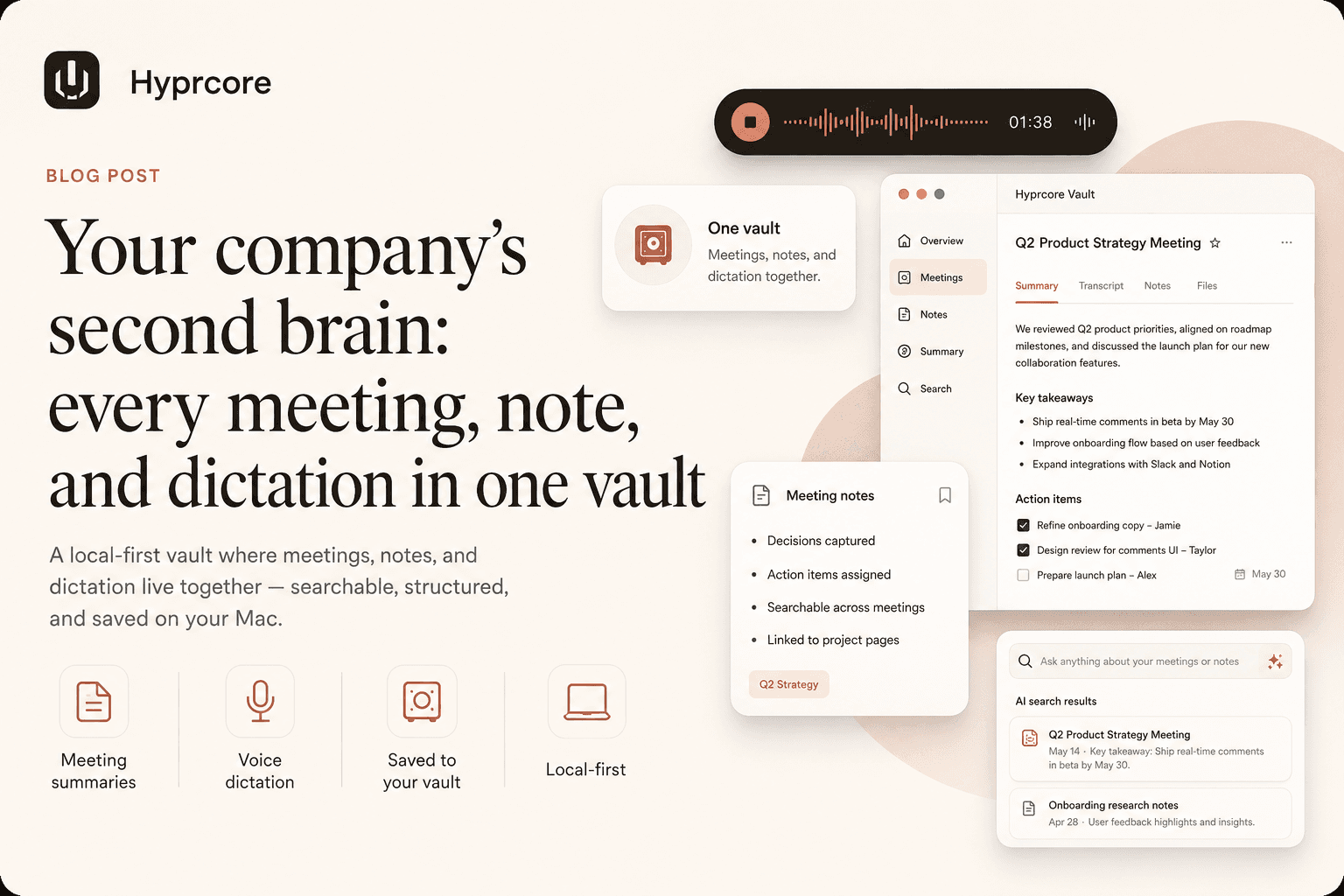
Your company's second brain: every meeting, note, and dictation in one vault
The "second brain" was supposed to hold everything you know. For most teams it holds everything you typed — and quietly loses everything you said. Here is what a second brain looks like when meetings, dictations, and notes share a single local-first vault, and why that changes what your team can remember.
Ten years ago, Tiago Forte gave a name to something a lot of people were already reaching for: a "second brain." The pitch is simple and good. Your biological brain is for having ideas, not storing them. So you build a trusted external system — capture what matters, organize it, and get it back the moment you need it. The book that followed, Building a Second Brain, turned it into a movement, complete with a method (PARA: Projects, Areas, Resources, Archive) and a generation of apps to host it.
The method is deliberately tool-agnostic. People build their second brain in Obsidian, Notion, Tana, Mem, Roam, Apple Notes — whatever holds plain text and lets ideas link to each other. Obsidian became the purist favorite for a specific reason: it is a folder of plain markdown files on your own disk, wired together with backlinks. No server owns your thinking. That is a genuinely great foundation.
But there is a hole in almost every second brain, and it is the same hole in all of them. They capture what you type. They lose what you say.
The half of your knowledge that never makes it in
Think about where the load-bearing decisions in your week actually happen. The pricing call. The architecture argument. The customer interview where someone said the one sentence that should reshape the roadmap. The 1:1 where a report told you, carefully, that something is wrong. Almost none of that gets typed into your vault. It happens out loud, and then it evaporates.
A modern knowledge worker speaks far more words at their computer than they type. Six meetings, a dictated Slack reply between two of them, a voice memo on the way to lunch. The second-brain apps were built for the typing knowledge worker of 2015. The talking knowledge worker of 2026 has a second brain that is, structurally, half-empty.
The usual patch is a second app. Otter or Fireflies for the meetings, Wispr Flow for the dictation, the second-brain app for everything else. Now you have three knowledge stores that do not know about each other, and "search my second brain" quietly means "search one third of it and hope the rest was important enough to copy over by hand."
What "one vault" actually means
Hyprcore starts from a stubborn premise: every word that comes out of your mouth or your keyboard belongs in the same place. Not synced between three places. The same place. We call it the vault — a real folder tree of markdown pages on your Mac, the same substrate Obsidian fans already trust, with one difference. The meetings and the dictation write directly into it.
Concretely, here is what lands in a single vault:
- Notes you type — pages, folders, icons, cover images, and a sidebar tree that works the way you think. A real wiki, not a notes drawer.
- Meetings you record — when you stop the recorder, the call becomes a vault page: full transcript, an AI summary, action items, speaker labels, and the video under the meta. It is filed, linked, and searchable like any other page, because it is one.
- Words you dictate — a global push-to-talk lands transcribed text at your cursor in any app, and anything you dictate into Hyprcore lands in the same tree.
Because it is all one store, ⌘K searches across the whole thing in real time — calls, notes, and dictations together. The decision you are hunting for does not care whether you typed it or said it out loud eight days ago. Neither does the search box.
“A meeting recorder without a vault is a graveyard for decisions. A vault without your meetings is half a second brain.”
From a personal vault to a company brain
The most interesting thing happening in knowledge management right now is the jump from a personal second brain to a shared one — a company brain. Meta has talked publicly about an internal "second brain" rolled out to tens of thousands of employees, with a team-level layer where individual workspaces feed a shared context that agents can read. The pattern repeats everywhere it is tried: the highest-value input is not raw transcripts, it is concise meeting summaries — the decisions, the commitments, the reasoning behind a choice — fed into a store that both people and AI can query.
That is exactly the shape a meeting-native vault produces. Every call already resolves to a clean page with a summary, action items, and a link back to the source line of the transcript. You are not building a company brain as a side project; it accretes as a byproduct of recording the meetings you were going to have anyway.
Sharing is where most "company brain" stories get nervous, and rightly. So the bar in Hyprcore is end-to-end encryption: sync is opt-in per meeting, the content encrypts with a key derived on your device before it leaves your Mac, and we hold ciphertext, not content. Invite a teammate and the key wraps for them; stop sharing and it goes away. A shared brain should not mean handing your conversations to a vendor in the clear.
A brain your AI tools can actually read
A second brain that only a human can open is already behind. The reason the "AI second brain" became a category in the last two years is that a vault of plain text is the perfect thing to point a model at — it is the knowledge base agents search before they answer. The teams getting value out of this are not pasting context into a chat window by hand; their tools reach into the vault directly.
Hyprcore exposes the vault over the Model Context Protocol, so an assistant like Claude can list your meetings, read a transcript, pull action items, or look up a person across calls — grounded in what was actually said, with citations, not a hallucinated paraphrase. As of v1.1, connecting it is one click: an Integrations panel wires Hyprcore into Claude Desktop, Codex, Cursor, and other AI tools, with a built-in connection test so you know it is live before your next call. And if you live in the terminal, there is now a read-only "hyprcore" command line — list meetings, read transcripts, and search your vault straight from the shell.
And the in-app intelligence is climbing toward the same thing from the other side. The recorder's Ask tab answers questions live during a call; a structured memory graph (people, topics, and commitments pulled out of every meeting) and cross-meeting AI search are both in progress — ask once, get an answer drawn from every meeting you have ever recorded, sources always linking back to the original line. That is the difference between a brain that stores and a brain that recalls.
Why local-first is non-negotiable for a brain
Obsidian people already know this in their bones: a second brain you do not own is a rental. If the company disappears, your thinking should still open in a text editor. So the meetings and dictation hold to the same rule the notes always did.
- Dictation runs on-device. Six local speech models — Whisper Small, Medium, Turbo, Large, and Parakeet V3 — run on Apple silicon. Turn off Wi-Fi and it still works.
- Meeting audio is captured and transcribed on your Mac, not uploaded to a vendor first. The transcript is written to disk as markdown you can open without us.
- The newest engines (NVIDIA Canary) even translate while you talk, so a non-Latin or multilingual meeting still lands as clean, searchable text in the vault.
- Anything that leaves the machine — a cloud AI summary, a shared meeting — is a step you opt into, end-to-end encrypted, not the silent default.
This is the same instinct that made Obsidian beloved, extended to the things you say. Plain files, on your disk, that you could walk away with tomorrow.
How to actually structure it
If you are coming from a PARA setup in Obsidian or Notion, the mental model carries over cleanly. A few things that work in practice:
- 01Let meetings file themselves, then move them. New vaults seed Work, Personal, and Archive folders. Let calls land, and once a week sweep them into the project or area they belong to — the same review habit PARA already asks of you.
- 02Write meeting templates per type. A 1:1, a customer interview, and a standup want different summaries. Edit the prompt each template uses once, and every future call of that type gets summarized the way you actually need it.
- 03Link out from the summary. The summary is the page that gets reread; the transcript is the archive. Link the decision in a meeting summary to the project page it affects, and your backlinks start mapping how choices flow through your work.
- 04Dictate the thought before it is gone. The fastest capture in any second brain is the one that needs zero app-switching. Push-to-talk into the current page beats opening a note to type three sentences you will lose first.
- 05Point your AI at the vault, not your memory. When you need "what did we decide about pricing," ask the tool that can read the vault over MCP rather than reconstructing it by hand. Let the brain do recall.
Where Hyprcore fits next to the tools you know
To be clear about lanes: if you have spent two years curating an Obsidian vault with a hundred plugins, Hyprcore is not asking you to throw it away. Obsidian, Notion, and Tana are excellent at the typed half of a second brain. What they do not do is sit on your calls and turn the spoken half into pages without a copy-paste tax.
Hyprcore is the tool for the part those apps leave on the floor — the meetings and the dictation — wired into a vault that behaves like the one you already trust: local markdown, a real tree, backlinks, ⌘K everywhere. If you want one place where the words you type and the words you say finally live together, that is the whole idea. If you are a small team and want that place to quietly become a company brain your AI tools can read, that is the next idea.
There are a lot of words floating around your day, and most of them are spoken. They should all land somewhere you can get them back. Hyprcore is free to download and runs natively on macOS — try recording one meeting and watch it become a page in a vault that already knows everything else you said this week.
More reading
Try Hyprcore
One workspace for the words you type, dictate, and record.
Native on Mac and Windows, local-first by default, and free to download.